Service

AI automation and implementation

Use AI where it adds practical value, such as reading documents and extracting information, inside workflows with validation rules and human review.

Sound familiar?

The problems this solves

  • Information arrives in documents, emails and images that someone has to read and re-type.
  • Unstructured data cannot be fed into your systems without manual handling.
  • You are under pressure to "use AI" but cannot see where it would make a measurable difference.
  • An AI pilot produced impressive demonstrations but cannot be trusted in daily operations.
What I deliver

Typical projects

Examples of the work this service covers. Most projects combine several.

Document data extraction

Invoices, delivery notes, purchase orders and forms are read and their key fields extracted, with every value traceable to the document it came from.

Verification against business records

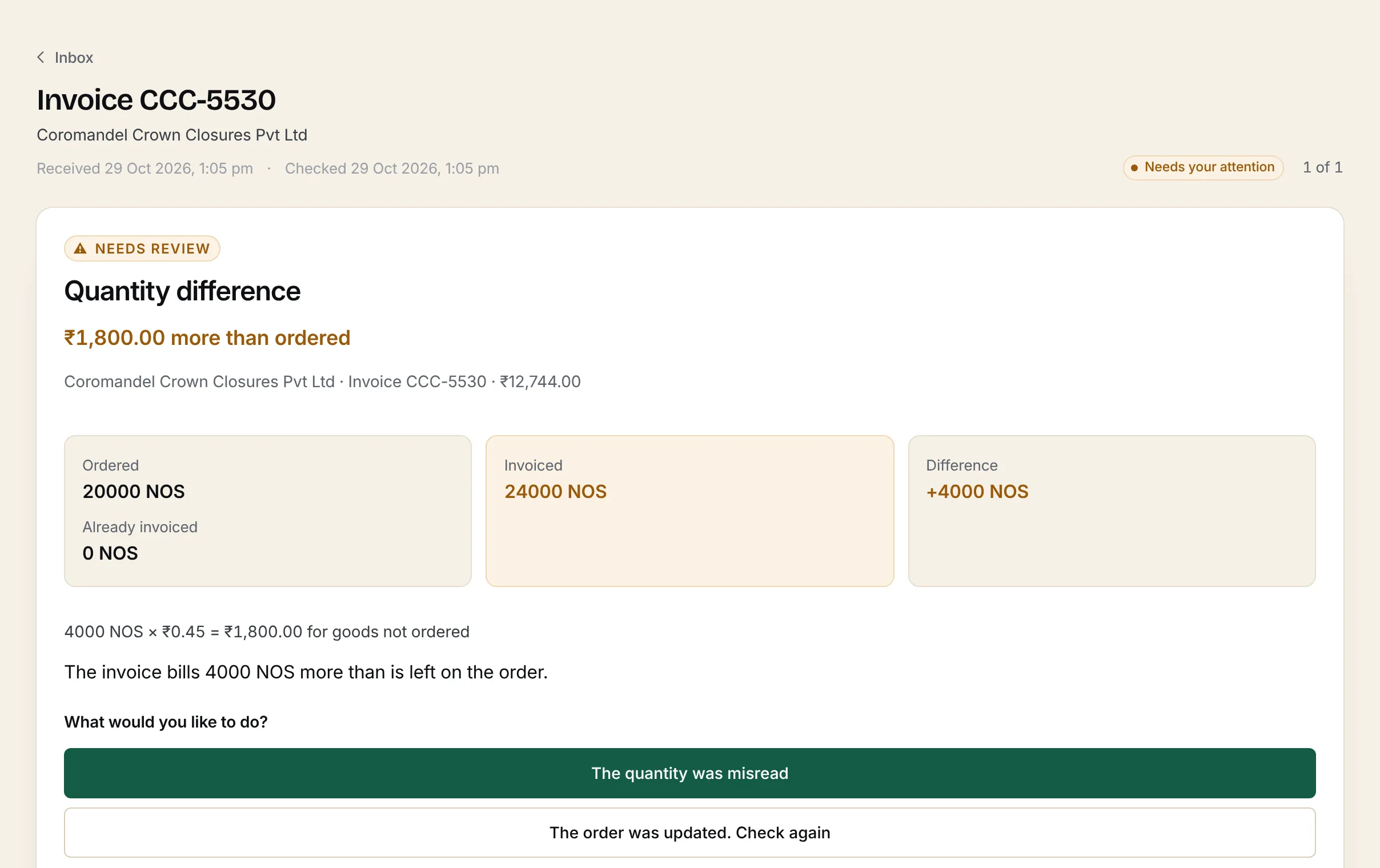
Extracted information is checked against your own records, such as purchase orders and receipts, so discrepancies are flagged for review rather than passed on.

Classification and routing

Incoming requests, emails or issues are categorised and routed to the right team, with uncertain cases sent to a person.

Assisted data processing

Large or messy datasets are cleaned, matched and structured with AI assistance, with rules deciding what is accepted.

AI as one tool among several

AI is genuinely useful for some business problems, especially reading unstructured documents and text. It is also unpredictable in ways that ordinary software is not. A sensible implementation uses AI for the steps it does well and surrounds it with deterministic rules, checks and human review.

How it works

How I implement AI in a workflow

  1. Confirm the problemDefine the decision or task, the volume and the cost of getting it wrong.
  2. Choose the simplest effective approachConventional parsing, rules or integration first. AI where they cannot do the job.
  3. Ground the outputExtracted values must be traceable to the source document, and the system should say when it is unsure rather than guess.
  4. Validate against your recordsCompare what the AI produced with purchase orders, master data and business rules.
  5. Keep people in the loopUncertain or inconsistent cases go to a person with the evidence needed to decide quickly.
  6. Measure in productionTrack how often results are corrected, so the workflow can be improved with evidence.
Proof of work

Related projects

My own productIn active development

Veyrafy

My own product for verifying supplier invoices. It reads invoices, checks them against purchase orders, goods receipts and supplier records, and asks a person when something does not match.

Read the case study →
FAQ

Common questions

Is AI accurate enough for business data?

On its own, not always. That is why the AI output in a workflow I design is treated as a proposal. Validation rules, comparison with your business records and human review of uncertain cases decide what is accepted.

Will our data be sent to an external AI service?

It depends on the design. Some tasks can run on models hosted within your own environment, and others use external services under their data terms. Where your data goes is an explicit decision we make together, not a default.

How do we know whether AI is worth it for a process?

Start with the volume, the cost of the manual step and the cost of an error. If conventional software can do the job reliably, that is usually the better choice. I will say so.

Insights

Further reading

Have an operational problem worth solving?

Tell me what is slowing your team down and which systems you use today. You do not need a technical specification: describing the problem is enough to start.

Request an AI implementation discussion