Confidential clientIn progress
FreshRoute Produce (pseudonym)
A WordPress website revamp for a fruit distribution business in the UAE, with planned and in-progress integration across ecommerce, inventory, ordering and payments.
Read the case study →For businesses in Dubai, Abu Dhabi and across the Emirates that need their systems connected, their manual work automated, or software built around the way they operate.
The UAE is introducing electronic invoicing in phases. Your ERP or accounting system has to produce structured invoices and exchange them through an accredited service provider, which is an integration problem as much as a tax one.
With VAT and Corporate Tax, sales, purchase and payment records have to agree across systems. Integration and automated checks reduce the month-end reconciliation that finance teams do by hand.
Website, marketplace, delivery app and WhatsApp orders flowing into inventory and accounts automatically, instead of being re-keyed by staff.
Order confirmations, delivery updates and service requests through the WhatsApp Business API, connected to the systems that hold the order.
Customer, supplier and staff portals that work in Arabic and English, including right-to-left layouts.
Businesses running several legal entities, branches or free zone companies, with data that must be consolidated without manual exports.
UAE businesses tend to grow quickly and across channels: a showroom, a website, marketplaces, delivery apps and a sales team on WhatsApp, often across more than one entity. Each channel usually arrives with its own software. The result is familiar: orders re-typed into the accounting system, stock that does not match between the website and the warehouse, and finance teams reconciling exports at month end.
Regulation adds to the pressure. VAT, Corporate Tax and the move to e-invoicing all depend on records that are complete and consistent across systems. That is difficult when the systems do not talk to each other.
I work with owners and operations and finance leaders across the Emirates, remotely day to day and on site when a project needs it. A typical engagement starts with a conversation and a short discovery exercise. In it we map how information moves between your systems today, where it breaks, and which improvements would pay back first. Delivery then runs in stages, each one tested with realistic data and reviewed with you before it touches live operations.
You have one accountable point of contact who understands both the business requirement and the technical work. Specialist developers are brought in where the work needs them.
Connect the software your business already uses so information moves between systems reliably, without re-keying, spreadsheets in the middle or manual reconciliation.
Connect your ecommerce website with inventory, ordering, payments and back-office systems, so online sales run through operations without manual handling.
Find the repetitive, error-prone work in your operations, simplify the process, then automate it with clear rules and a defined place for human judgement.
Build business applications, internal tools and web platforms when off-the-shelf software cannot support the way your business works.
Confidential clientIn progress
A WordPress website revamp for a fruit distribution business in the UAE, with planned and in-progress integration across ecommerce, inventory, ordering and payments.
Read the case study →Client project
A school-based hamper management initiative in the UAE that teaches children practical leadership and sales skills through managing hampers, supported by a digital platform.
Read the case study →My own productIn active development
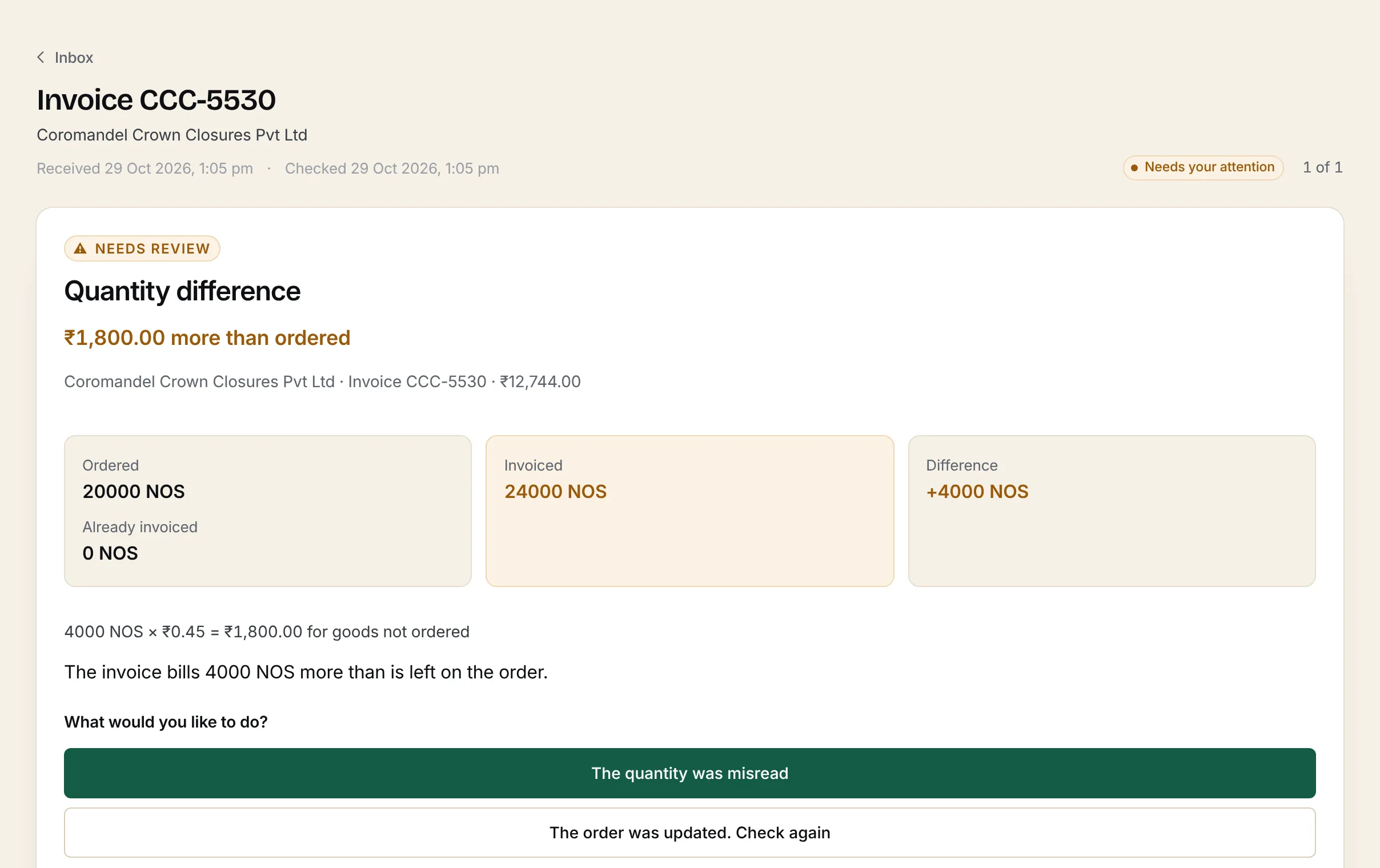
My own product for verifying supplier invoices. It reads invoices, checks them against purchase orders, goods receipts and supplier records, and asks a person when something does not match.
Read the case study →Yes. My UAE work includes a fruit distribution business and a school-based initiative, both described on this site, as well as work for other established UAE organisations whose names are kept confidential.
I am based in Bangalore, India, and work hybrid. Day-to-day delivery happens remotely, through video calls, shared documents and regular reviews of working software, and I make site visits when a project needs them, for example for discovery workshops or a go-live. There is no UAE office.
Yes, on the systems side. That means assessing whether your ERP or accounting system can produce the required invoice data, how it will connect to your chosen accredited service provider, and what has to change in your processes. Tax advice remains with your tax adviser.
These are among the most common systems in the UAE, and the approach is the same for each. Find out what the system can exchange through its API or import tools, then design reliable flows around it. Each project starts with checking this in your own setup rather than assuming it.
Businesses anywhere in the UAE, including Dubai, Abu Dhabi, Sharjah and the Northern Emirates. Delivery is hybrid, so location within the country makes no difference.
Installing the PayTabs plugin takes minutes. Order statuses, payment notifications, refunds and reconciliation take planning. A guide for UAE and GCC businesses.
· Read →Every UAE business in scope for e-invoicing needs an Accredited Service Provider. Ten practical questions to compare ASPs on systems, onboarding, errors and cost.
· Read →A practical guide to UAE e-invoicing for finance and operations teams: the Peppol model, the Accredited Service Provider and what to change in your systems.
· Read →Tell me what is slowing your team down and which systems you use today. You do not need a technical specification: describing the problem is enough to start.